Showing posts with label Backyard Chickens. Show all posts

Friday, April 6, 2012

Chickens Love Treats

What do chickens eat?  I think the bigger question is "what don't chickens eat?".  I once saw a chicken grab an entire hamburger off of my husbands plate.  She and her sisters ate the whole thing from the patty to the bun.  I've never laughed so hard, but it really got me thinking about chickens and their diet.  That was the day I realized chickens are NOT vegetarians, no matter how cute them seem starting out.

Chickens are opportunistic omnivores meaning that they eat just about anything that crosses their paths.  They originated in the jungles of Southeast Asia where they enjoyed a varied diet of vegetation, fruit, seeds, bugs, slugs, worms and even, small animals like frogs, lizards, and mice.  

From an early age, we fed our chickens grub worms and grasshoppers that we came across while out in the garden.  Chickens are naturally curious, but understandably cautious when encountering something new.

Anyone who has ever seen a chicken chow down on a burger can definitely appreciate how a group of chickens could consume a large piece of food.  When chickens encounter a piece of food that is too big to swallow, they play a fun game.  The chicken with the food starts running around.  This tells the other chickens that the game is on.  The object is to rip and pull at whatever food the holding chicken has.  This continues until the food is small enough to eat and everyone gets a little bite of food along the way.  Interestingly, the chicken starting the game seldom ends up with the food in the end.

A balanced diet is important for a chickens health, so I feed my chickens a commercial ration which contains all the nutrition a chicken needs to stay fit and lay lots of eggs.  Commercial rations are available in pellets, crumbles, mashes and organic varieties.  Whatever food you choose, be sure to keep the food clean and dry.  Hanging the ration will keep the chickens from spoiling the food with droppings or knocking it over as chickens will do.

Selecting the appropriate chicken feed can be a little confusing with all the options available, so I've made a chart to help explain the various feed options and their costs.  Two great local stores for purchasing feed are Callahan's General Store (southeast Austin) and Buck Moore Feed Supply (north central Austin).  Both stores have excellent staff which will be happy to assist you with your feed questions.

Food and Supplements
Age to Feed
Description
Amount to Feed*
Cost (Approx.)
Chick Starter Grower
0 – 20 weeks
Combination starter grower feed use for first 4 months
¾ lb. per week
$5.00 per 10 lb. bag
$11.90 per 50 lb. bag
Organic Chick Starter
0 – 6 weeks
Initial food for baby chicks
¾ lb. per week
$16.50 per 20 lb. bag
Organic Pullet Grower
6 – 20 weeks
Growth formula for chicks
¾ lb. per week
$15.50 per 20 lb. bag
Lay Pellets
20 wks & up
Large pelletized food (20% protein) for laying hens.
3 lbs per week
$12.35 per 50 lb. bag
Lay Crumbles
20 wks & up
Broken up pellets (20% protein) for laying hens
3 lbs per week
$12.35 per 50 lb. bag
All Mash Pellets
20 wks & up
Large pelletized food (18% protein) for laying hens.
3 lbs per week
$11.90 per 50 lb. bag
All Mash Crumbles
20 wks & up
Broken up pellets (18% protein) for laying hens
3 lbs per week
$11.90 per 50 lb. bag
Organic Layer
20 wks & up
Served dry or as a mash to laying hens
3 lbs per week
$31.95 per 50 lb. bag
Scratch
8 wks & up
A treat provided to chickens
Sparingly as a treat or training device
$5.00 per 10 lb. bag
Oyster Shell
20 wks & up
A calcium supplement for shell hardness
Supplement if needed
$1.25 per 5 lb. bag
Grit
20 wks & up
Generally not required when using commercially prepared feed
Supplement if needed
$5.00 per 5 lb. bag
Homemade Feed
varies
Recipes vary
Varies
Cost Varies
Kitchen Scraps
20 wks & up
Chicken like a variety of food especially seeds and leaves
Vegetable trimmings in good condition.  Never feed a chicken moldy or rotten food.
Free
* Use amounts as a guide.  The recommended feeding method is free-choice where food is always available.


Sure a balanced diet is important, but CHICKENS LOVE TREATS!  Here are some of my chicken's favorite treats:

·         Yogurt
·         Raisins
·         Fruits, especially seeded fruits like tomatoes
·         Black-Oiled Sunflower Seeds
·         Oatmeal
·         Cabbage

Chickens like to have fun with their food.  So, how about a game of chicken tetherball to break up the monotony.  Tie a head of cabbage up where it can swing freely and you'll have hours of fun on your hands.

Interested in more about chickens?  How about coming out for the Funky Chicken Coop Tour this Saturday, April 7, 2012, from 10 a.m. to 4 p.m.  You can tour coops, see some cool chickens and talk to some backyard chicken folks.  Sounds like fun!  I hope to see you out there. 

Wednesday, December 21, 2011

Chicken Tetherball Tournament

Welcome to our 2nd Annual Chicken Tetherball Tournament.

The contestants and spectators have been eagerly awaiting the tournament, which is held each year when the cabbage is ready for harvest.  The cabbage is tied securely and ready for play.  
 
So, let's play some chicken tetherball ...

The contestants take their marks.

The action is frantic as contestants try to get a beak on the ball.

The determination is palpable.

Watch out Barney, Pansy takes her tetherball pretty seriously.

Looks like Pansy was planning her attack.  The crowd watches in stunned amazement as Pansy steals a piece of the ball.

Uh oh... There's a flag on the play.

What? Barnie's throwing down the challenge flag.

"Quit goofing off.  I'll accept the penalty", says Pansy

Game back on.  Let's have a clean game girls.

And the winner is ... drum roll please... 
Ginger, the tetherball queen.

Monday, November 28, 2011

Broody Chicks Lay No Eggs

I came home one day to find my Welsummer hen, Petunia, behaving strangely.  She would not leave the nest and upon my approach, she puffed herself up and growled at me like some sort of possessed gremlin.  At first I thought she was sick, but after some research I came to the conclusion that she was most likely broody. 

When a hen becomes broody, her hormones take over and she feels a need to hatch some chicks.  She plucks out her breast feathers to provide more warmth to the clutch of eggs that she will sit on for 28 days.  She will only leave the eggs for brief periods to eat and drink.

So, here’s the problem.  I don’t have a rooster, and Petunia doesn’t understand that the eggs she is sitting on have not been fertilized.  She will continue to sit on the eggs indefinitely, and the eggs will never hatch.  Continuing to sit on eggs in vain is not good for Petunia, since she will weaken without enough food.  Petunia will not lay eggs while she is broody and general egg production in the coop may diminish as well.  This is not good for me, because I've grown to enjoy eggs for breakfast.   

I decided to try some of the suggestions I found on the web.  The first suggestion was to remove the eggs and replace them with a Ziploc baggie full of ice cubes.  Though Petunia was extremely outraged by this incursion, the idea seemed to work at first and she left the nest.  Eventually hormones won out and, despite the ice, she decided to return to her egg sitting.

The second suggestion was to isolate her in a special cage without nesting material.  The recommendation was for a wire cage designed to promote good air flow under her.  We re-purposed an old dog crate and retrofitted the bottom with hardware cloth to create a more solid floor.  We propped the cage up on cinder blocks and placed it back in the coop for security against marauding raccoons. 

Petunia lived in the broody coop, as we came to call it, for 5 days.  I checked on her often and brought fresh food and water daily.  Eventually she stopped growling and I knew she was coming out of her hormone induced broody state.  The idea worked and Petunia was able to rejoin the rest of her sisters.  Life was back to normal and eggs were back on the menu.

Sunday, November 27, 2011

Winterizing the Coop

The design of our backyard chicken coop takes into consideration both the scorching Texas summers and the biting cold fronts of Texas winters.  During the summer, the coop is enclosed on three sides.  The fourth side is left open providing optimal air flow.


In the winter, the coop can be enclosed.  Two separate doors are used to form the wall.  In the fall, we add the door to the roost end of the coop to provide protection from the wind at night.  When temperatures turn colder, the second door in added to fully enclose the space.  Each door is hung on two large gate hinges, which allows them to be easily installed or removed.  The lexan windows allow in light, and the cutout door allows the chickens to enter.


A heat lamp above the roost provides a little extra warmth and protection.  Last winter I thought I would spoil my feathered friends by turning on the lamp frequently.  One night, I went out to the coop and discovered the girls had vacated the coop because it was just too hot.  Chickens are actually pretty hardy birds, so now I reserve the heat lamp for nights when temperatures are going to drop below freezing. 

Monday, November 21, 2011

Which Egg Do You Prefer?

While the debate continues about whether free-range chicken eggs are better than grain fed chicken eggs, let me ask one question.  Which egg would you prefer? 


Of the four eggs pictured, the two pale-yolked eggs are regular grocery store eggs, and the two orange-yolked eggs were laid by my backyard chickens.  I think Cocoa and Ginger were responsible for these particular specimens.  Thanks girls.

The eggs produced by my chickens have a very hard shell, a rich, orange-colored yolk, and a meaty white.  Contrast this with your standard grocery store eggs, which have pale yellow yolks, runny whites, and shells which crack quite easily.

Why are these eggs so different?  It all comes down to diet.  Chickens are omnivores.  A chicken fed a balanced diet including greens, produces an egg with a dark yellow or orange yolk.  The color in the yolk comes from a class of substances called carotenoids, which are found in many fruits and vegetables.  If carotenoids are good for you, and free-range chicken eggs contain carotenoids… well, I’ll let you do the math.

A chicken doesn’t necessarily have to be free-range in the purist sense of the word to produce a quality egg.  My chickens do not “free-range” due to an abundance of hawks where I live.  I do allow them to leave the coop from time-to-time, but their field trips are largely supervised by my husband and me. 

The overriding factor in producing a quality egg is diet.  My chickens are fed vegetable scraps, rice, oatmeal, and lots of other food items that I used to toss into the compost bin.  A balanced grain-based feed is available each day, but trust me, when I show up with the day’s treats, all bets are off.  Chickens may not be the brightest pet you'll ever own, but they still know what tastes good.

Monday, November 14, 2011

Feather Picking

This summer my small backyard chicken flock was afflicted by a problem called cannibalistic feather picking.  It is not uncommon to encounter this problem even when you think you’re providing your birds with the best possible care.  Some breeds are more prone to cannibalism, plus stress, molting and dietary issues can all contribute.  The problem can be very severe, even resulting in death.

My small flock was under stress at the time of the first feather picking incident.  The summer heat was relentless and the birds were continuously molting.  At this same time, I decided to change the feed from a laying pellet to an organic feed ration.  Compared to the pellets, the feeding ration was powdery with bits of cracked corn and seeds.  The chickens immediately started rifling through the feed to pick out the best parts.  Most of the feed ended up on the ground.  They were going through feed at 2-3 times the normal rate.  I allowed the feeder to go empty a couple of times thinking they would eat the feed on the ground.  Boy, was I wrong.

Petunia was the unfortunate victim of the feather picking.  She was being pecked heavily on her back and tail feathers.  By the time I discovered the problem, the other chickens had drawn blood and she was scared and half crazed from their attacks.

I immediately removed her to a protected area and soothed her raw back with Vaseline.  I had to keep her separated from the others until she healed. There are special products, such as pine tar and chicken saddles, to help deal with this problem.  I read mixed reviews on these products, so I decided to stick with isolation and Vaseline, which both worked fine.

I read that a protein deficiency might be the cause of the feather picking, so I started supplementing the chicken’s diet with tuna, black oil sun flower seeds, yogurt, and oatmeal.  Luckily, the feather picking stopped almost immediately following the protein boost.

The second victim of feather picking was Cocoa.  Cocoa’s feather picking problem is a little different.  She is being pecked on her neck feathers.  

The only pecking I have observed occurs during roosting and appears to be part of a power struggle for roost position.  I don't think it's diet related, but I am continuing to supplement their diet with extras.  I have also started providing alfalfa hay, which I read that chickens like.

The resolution to Cocoa's problem is up in the air.  Poor Cocoa still has a naked neck, but she doesn’t seem to be distressed about it.  I haven't witnessed any overt attacks while monitoring the flock, so I'll just have to continue to be watchful.   

Monday, November 7, 2011

The Dirty Truth

Raising backyard chickens can be very rewarding, but I would be remiss if I didn’t tell you the dirty truth:  chickens are messy.  Chickens eat all day, so naturally, they poop a lot.  Chicken poop, while not exactly toxic waste, is pretty darn close.  
   
Cleaning the coop is a weekly job that should not be overlooked.  A dirty coop can be harmful to the health of your flock, and your neighbors probably won't be too happy about it either.

A well thought out coop design can simplify cleaning.  For example, a sand floor can help keep the ground dry and makes it easier to rake out the debris.  

Installing poop boards under the roosting area is another good idea. The boards collect the the nightly droppings and assist in keeping the coop floor clean.  Poop boards that are removable can be washed more easily and left in the sun to dry.  

A regular once a week cleaning has been working pretty well for my small flock.  My tools of the trade are a rake, putty knives, a kitty litter scoop, and a bucket.    

First, use the putty knife to scrape the poop boards.  A metal putty knife is essential for scraping.  Chicken poop seems to have the holding power of super glue.

Next, move on to cleaning the floor.  Skim the top surface of the sand with the back side of the rake and remove the debris pile.  Use the tines of the rake to turn up clean sand and rake the surface smooth.

A kitty litter scoop is a handy tool for sifting the debris out of the sand.


Don't forget, chicken poop makes a great addition to the compost bin.

Sunday, October 9, 2011

Meet the Chicks

In the world of the chicken, the pecking order is very literal.  Chickens at the top of the pecking order do all the pecking, and chickens at the bottom of the pecking order get pecked.  Sometimes the pecks are gentle reminders that those with privilege can belly up to the feeder at the choice location.  Other times the pecks must strike a nerve, because noisy scuffles erupt as the peck-ee decides to fight back.  

Here's the chickens in pecking order...
Ginger is a golden sexlink.  She is the head chick and has been since day one.  A once benevolent queen, Ginger has been a little cranky this summer, pecking her sisters in a most unfriendly way.  I’m hoping it’s just the heat, and once the weather cools down, she will chill out (so to speak).

Dottie is a silver laced wyandotte.  She is Ginger’s lieutenant and right-hand chick.  Dottie is the most handsome chicken in flock with lovely feather coloration and a plump figure.  She sternly watches over the coop for any signs of trouble, but seems to let Ginger handle any needed discipline.

Cocoa is a cuckoo moran who was a late comer to our flock.  She was a replacement for Dottie’s sister, Wynnie, who we think died of egg impaction.  Cocoa is a scrappy chick, who has fought her way up the pecking order with pure determination.  She really thinks she is in charge, until Ginger reminds her differently.  Those reminders have cost her a few neck feathers lately.

Pansy and Petunia are my middle children (I mean chickens).  They are welsummers, which are known for their dark terracotta colored eggs.  Petunia was the first and only chicken so far to become broody.  A broody hen experiences an overwhelming need to sit on eggs until they hatch.  She stops laying eggs herself, refuses to leave the nest, and eats and drinks very little.  Petunia has actually been broody twice.  Poor thing wants to hatch some babies, but without a rooster there’s not much chance of that happening.

Last but not least is Barnie, so named because she is a barnevelder.  Normally, a very attractive breed, Barnie has always been a bit of an ugly duckling.  She has a very large crop goiter, but still manages to get around.  Since the beginning, Barnie has been at the bottom of the pecking order.  She doesn’t seem to mind and actually seems to prefer people over chickens. 

In the picture below, Barnie has dug out a hole for a dust bath.  Unfortunately, she didn't get to enjoy it.  Once the other chickens saw what she was doing, she was forced out of her hole and the others scrabbled for hole privileges.  Thus is the life of those at the bottom of the pecking order.

"It's okay Barnie, I'll get you a special treat later."

The gang of six enjoying a few fresh black-eyed peas from the garden.


Thursday, October 6, 2011

Taj Ma-Coop

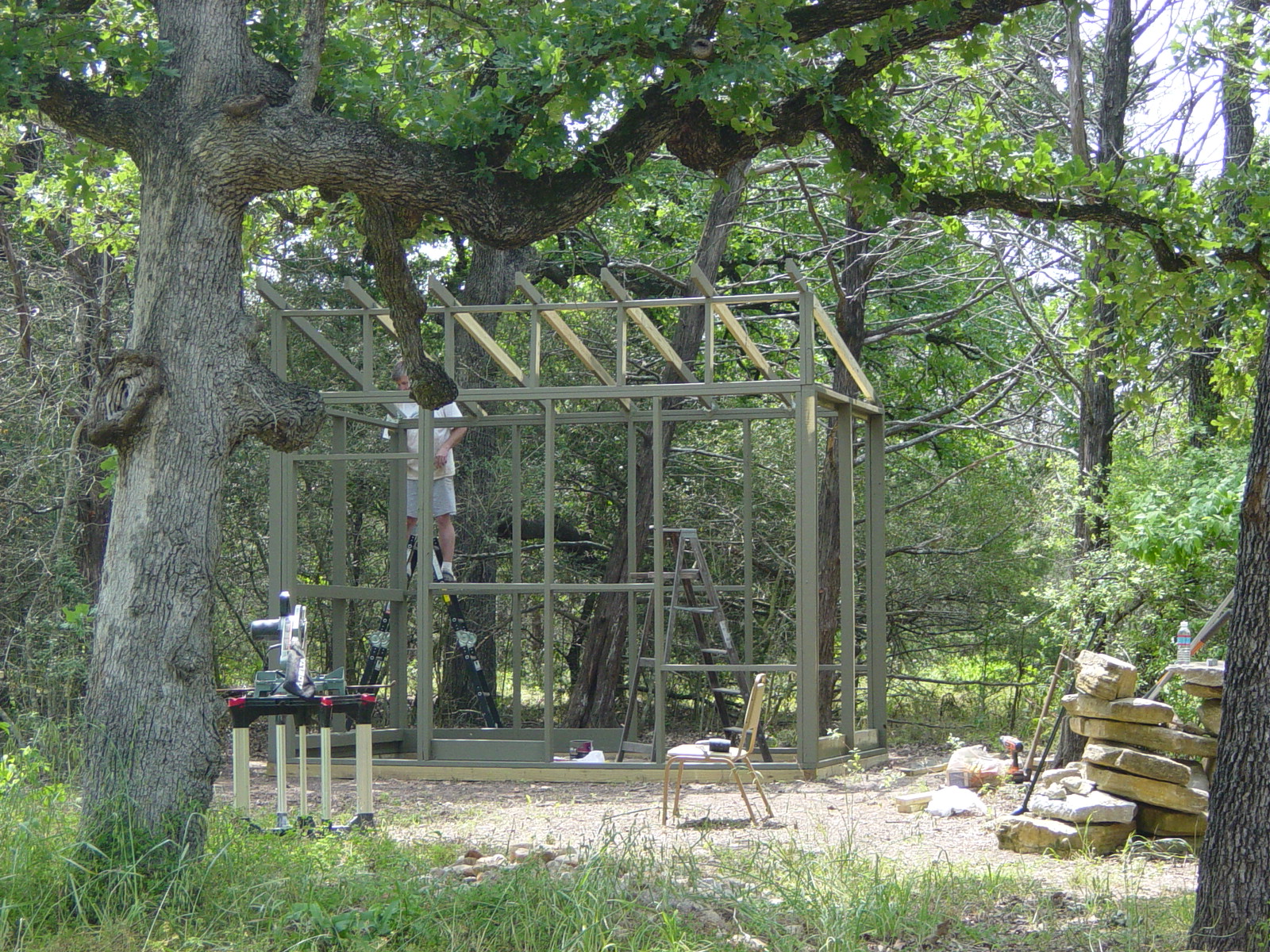
My backyard is racoon central, so I knew when we decided to raise chickens that we would need a predator proof coop.  I found some great ideas on the web to help us build this 8 X 12 coop and run combination.  First, we layed out a 4"X4" foundation and built the frame.

Painting the frame will protect the wood and make it look nice.

Hardware cloth, also called 1/2 inch wire, is secured to the frame with screws and washers.  The chicks will be safe as long as the racoons don't figure out how to use screw drivers.

The hardware cloth is complete and the siding is installed.


The trim is added and a rock edging is installed around the coop.  Wire under the rock will further discourage digging pests.
 

A good locking mechanism secures the door.

The coop interior includes a roost, nesting box, and ladder.

The nesting box has a small roost area to make it easier for the birds to enter the boxes.

The L-shaped roost includes removeable poop boards for easier cleaning.

The finished coop has been in use for a year and half.  In the absense of an actual rooster, Roger the metal rooster stands guard over the girls.